
Trump has announced an 'Infinite Life' agreement with Denmark and Greenland, claiming it grants the United States permanent control over security and the ability to prevent adversaries from establishing a military presence or making sensitive investments on the strategically vital Arctic island.

The political confidence required to place high-end Japanese aircraft and personnel on Indian soil is itself a data point.
It indicates a level of trust that would have been difficult to imagine when India-Japan defence ties were largely symbolic, explains Varun Arya.

South African jurist Navanethem 'Navi' Pillay, of Indian origin, has been awarded the 2026 Nobel Peace Prize for her lifelong dedication to advancing human rights, peace, and international law, including her significant contributions to shaping international law on genocide and sexual violence.

India has strongly rejected a UN special rapporteur's report describing the Dawood Ibrahim-led D-company as an "India-based" criminal group, flagging "glaring inaccuracies" and cautioning against such incompetence. First Secretary Raghoo Puri stated that Dawood Ibrahim fled India much before his 2003 listing and is wanted in India for terror attacks since 1993, residing in the same country where Osama bin Laden was found. India also raised concerns about alleged bias in the report and funding allegations against the rapporteur.

Kerala Home Minister Ramesh Chennithala announced plans to strengthen the state police's Cyberdome to combat cybersecurity threats and deploy indigenously developed robots for traffic management and disaster response. He emphasised the need for coordinated efforts to address growing cyber challenges and protect critical infrastructure, while also highlighting the role of the CoCoN conference in sharing knowledge.

The flydubai near-tragedy showed how the gratuitous conflicts their governments started in West Asia have made the world unsafe for them (and unfortunate co-passengers of other nationalities), points out Kanika Datta.

Chinese President Xi Jinping's arrival in Washington marks a pivotal moment for global diplomacy, as he advocates for a "partners, not rivals" approach to US-China relations amidst high-stakes discussions on trade, technology, and international stability.

On the 25th anniversary of that world-changing morning in New York, it is also for the rest of to reflect. Not only on those who were killed but also on why the event happened and what led to it and what came after it, asserts Aakar Patel.

Reports from the New York Post, citing Mohsen Heydari, reveal that Mojtaba Khamenei was "pulled from the rubble" of a Tehran hospital after alleged US and Israeli strikes. This occurred before his secret selection as Iran's new Supreme Leader by the Assembly of Experts, which was also reportedly targeted. Conflicting accounts from Donald Trump and Iranian President Masoud Pezeshkian have further shrouded Khamenei's health in mystery, with some suggesting severe injuries while others claim he is "completely" healthy.

Israeli Prime Minister Benjamin Netanyahu announced a significant policy shift, declaring that Israel's robust economy no longer requires American financial assistance. He also reiterated strong opposition to Palestinian statehood, affirmed an aggressive national defence strategy, warned of pre-emptive strikes against Iran, and confirmed the continued military presence in southern Lebanon.

India's ruling Bharatiya Janata Party (BJP) is actively courting Sri Lanka's Janatha Vimukthi Peramuna (JVP), a Marxist party with strong Sinhalese nationalist roots, marking a significant shift in bilateral relations despite ideological differences. This engagement, highlighted by a recent high-profile visit by JVP leader Tilvin Silva, aims to foster cooperation on economic projects and address New Delhi's concerns over slow progress in India-aided initiatives in the island nation.

Shiv Sena (UBT) chief Uddhav Thackeray accused Chief Election Commissioner Gyanesh Kumar of acting as a 'weapon' for the ruling BJP, while MNS leader Raj Thackeray demanded the cancellation of Maharashtra's Special Intensive Revision (SIR) of electoral rolls, amidst a large protest march in Mumbai.
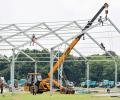
Kolkata's Brigade Parade Ground, a historic venue for political rallies and demonstrations, is set to host the swearing-in ceremony of Bengal's first BJP government, marking a significant shift in the state's political landscape. The ground has been a stage for political heavyweights and pivotal moments in Bengal's history.

Iranian President Masoud Pezeshkian urged BRICS nations to expand trade in national currencies and build an inclusive global economic framework. He criticised "unilateral sanctions" by Western powers, stating they make emerging economies vulnerable and impact global food security. Pezeshkian emphasised BRICS' role in creating a balanced world order and highlighted Iran's geopolitical and energy capacities for cooperation.

President Donald Trump has announced a promise to issue a USD 5,000 dividend to every adult US citizen if Republicans secure victory in both the House and the Senate in the upcoming midterm elections, citing the nation's economic success under his administration.

The successful hosting of the 18th BRICS summit in New Delhi has provided a significant boost to the BJP, offering a timely opportunity to strengthen its narrative against the opposition ahead of crucial assembly elections next year. BJP sources highlight the BRICS grouping's strong condemnation of the Pahalgam terror attack and the consensus declaration as major diplomatic victories for the Modi government, countering criticisms of its foreign policy. The party plans to leverage these outcomes during its month-long Seva Sankalp campaign to connect with various sections of society.

Former Army chief General Manoj Naravane asserted that while India's immediate attention is on Pakistan due to terrorism, China will be New Delhi's primary long-term competitor across political, economic, trade, and military domains, necessitating a strong military deterrence alongside dialogue.

'Eastern Ladakh set the relationship back by about 10 steps. So far, especially since Galwan, we may have taken just 4 steps forward.'

Lieutenant General Apti Alaudinov, deputy chief of the Russian Armed Forces' Main Military-Political Department, has warned that the escalating conflict in West Asia could lead to Israel ceasing to exist as a state, accusing Israel of seeking to widen the confrontation to involve the US and NATO.

Supreme Leader Mojtaba Khamenei has reshuffled Iran's political and national-security establishment, appointing former SNSC Secretary Mohammad Bagher Zolghadr as his political adviser and veteran IRGC commander Mohsen Rezaei as his representative on the Supreme National Security Council, consolidating power amid the West Asia crisis and Strait of Hormuz tensions.

Any military response to a cross-border terror attack from Pakistan will have to take into account the new alignments beginning to take shape in the region, points out former foreign secretary Shyam Saran.

'India is trying to project that it can engage with the world in a different way too.'

Students of Lovely Professional University (LPU) in Phagwara, Punjab, engaged in violent protests, vandalising property and clashing with police over unverified claims of a female student being raped on campus. The unrest led to the suspension of classes and postponement of exams, while police registered a rape case and formed an SIT, despite the university denying the allegations as 'rumours'.
Former Chief of Defence Staff Gen Anil Chauhan (retd) revealed that Prime Minister Narendra Modi directed an 'unthinkable' and 'big lesson' action against Pakistan following the April 2024 Pahalgam terror attack, emphasising India's zero-tolerance policy for cross-border terrorism and the need for irrefutable evidence.

A report by Scholars at Risk, 'Free to Think 2026', states that academic freedom in India is "severely restricted" due to increasing government influence over higher education, university governance, and curbs on student expression. India is listed among six countries in this category, with its Academic Freedom Index score sharply declining. The report cites instances of faculty dismissals, event cancellations, and pressure on student protests, highlighting the alleged use of the UGC as a vehicle for state influence.

'This is what we train for: That one chance to deliver a blow so lethal that the enemy will constantly think about it when planning any misadventure.'

Iranian Foreign Minister Abbas Araghchi has revealed the intense psychological pressure faced by Tehran's diplomatic delegation during peace negotiations with the United States, recalling a direct exchange with US President Donald Trump's Middle East envoy, Steve Witkoff, where he questioned the envoy about the constant military threats.

After a gap of nearly six years, the United States and India will hold their first political-military dialogue in New Delhi next week during which the two countries are expected to discuss a wide range of bilateral issues.

Prime Minister Narendra Modi, addressing the SCO summit in Bishkek, called for a united front against terrorism and its financing, rejecting double standards. He emphasised resolving conflicts through dialogue and diplomacy, not battlefields. Modi also highlighted that connectivity projects must respect national sovereignty and territorial integrity, a veiled reference to China's Belt and Road Initiative. India's vision for SCO rests on security, connectivity, and opportunity.

Japan is deepening its defence relationship with India while simultaneously expanding its economic, infrastructure and security engagement with countries around India -- particularly Bangladesh. The result is an emerging Japanese conception of South Asia in which India remains the strategic anchor, but the geography surrounding India is becoming increasingly important, points out Varun Arya.

The BRICS summit in New Delhi brings together leaders from major emerging economies to address global challenges like trade disputes, geopolitical upheavals, and the economic impact of conflicts in Ukraine and West Asia. India, as chair, aims to position BRICS as an economic growth engine, focusing on the Global South's food, energy, and supply chain security. The summit also highlights the grouping's expansion and its growing influence in global governance.

US Vice-President J D Vance's unexpected phone call to Prime Minister Narendra Modi on August 8 has ignited speculation about a potential diplomatic overture, possibly seeking India's support amidst the escalating US-Iran conflict and a shifting global power landscape, suggests Ambassador M K Bhadrakumar.

US President Donald Trump has reportedly urged Israeli Prime Minister Benjamin Netanyahu to withdraw Israeli military units from southern Syria and Lebanon, warning that Israel's continued presence could escalate regional tensions.

Karnataka home minister Priyank Kharge on Saturday rejected Bharatiya Janata Party leader B L Santhosh's claim that Rashtriya Swayamsevak Sangh workers had protected his (Kharge's) family from Razakars during Hyderabad state's integration with India, saying that his family and people of the region were protected by Sardar Vallabhbhai Patel, Jawaharlal Nehru and the Indian Army.

Rahul Gandhi recently connected with Gen Z through an engaging 'Ask Me Anything' session on Instagram, offering candid responses on student protests, his views on Prime Minister Narendra Modi, and even his philosophy on pet ownership.

Prime Minister Narendra Modi urged Russian President Vladimir Putin to move from 'endless war to the end of war' in Ukraine, emphasising that a peaceful resolution is humanity's shared priority.

India's position appears to be anchored around three red lines: Hasina's safety and the guarantee of a fair trial; assurances that Bangladeshi territory will not be used for activities hostile to India; and the restoration of an inclusive democratic process in Bangladesh.
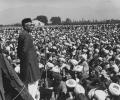
Sheikh Mohammad Abdullah's dismissal and arrest on August 9, 1953 marked a decisive shift in the Centre-J&K power equation. Seven decades later, the erosion of the state's special constitutional position culminated in the August 5, 2019 changes, notes Mohammad Sayeed Malik, the distinguished commentator on Kashmir affairs.

National Security Advisor Ajit Doval engaged in Special Representatives talks with Chinese Foreign Minister Wang Yi in Beijing, focusing on the India-China boundary question and enhancing bilateral relations. These crucial discussions precede Chinese President Xi Jinping's anticipated visit to New Delhi for the BRICS summit, aiming to address persistent border differences and stabilise ties strained by past conflicts like the Galwan Valley clash.

Dinesh Trivedi's success or failure in this fragile diplomatic equilibrium will have consequences extending well beyond the Indian high commission in Dhaka. It will shape India's eastern strategic environment for years to come.
